Structured Products in Digital Assets: A Governance-First Overview for Foundations
A governance-first overview of structured products in digital asset markets for foundations.
Crypto foundations face a distinct set of treasury challenges. Many hold large positions in native or ecosystem tokens acquired through grants, protocol allocations, or early participation. These holdings are often volatile, illiquid, and difficult to reduce without market, reputational, or governance implications.
At the same time, foundations must fund operations, support their ecosystems, and preserve long-term sustainability under board oversight and fiduciary constraints. Traditional treasury tools are not always well suited to these conditions. Against this backdrop, some foundations explore structured treasury approaches as a way to define risk exposure and conditional outcomes more explicitly, rather than to increase directional exposure.
This article provides an educational overview of structured products in the context of crypto-native treasuries, focusing on typical outcomes, embedded risks, and the respective roles of treasury, risk management, and governance.
What Are Structured Products in a Crypto Treasury Context
Structured products are financial instruments that combine an underlying asset with derivative components to produce predefined, conditional outcomes. In crypto treasuries, the underlying asset is often a native or ecosystem token rather than a diversified portfolio.
The utility of structured treasury approaches in this context lies in their ability to address specific constraints, including concentrated token exposure, long holding periods, and limited flexibility to sell without market impact. Structured products are not an asset class. They are a financial engineering framework whose relevance depends on treasury objectives, risk tolerance, and governance capacity.
Typical Outcome Profiles and Risk Trade-offs
Structured treasury approaches are often described by their intended outcomes. These outcomes are always conditional and involve trade-offs.
Income-oriented outcomes aim to generate periodic cash flows under defined market conditions. In crypto foundations, such approaches may be considered to offset operating expenses without immediate token sales. These outcomes typically require accepting specific risks, such as downside exposure or volatility. Adverse market movements can materially affect capital outcomes.
Capital-conditional outcomes seek to limit losses beyond predefined thresholds. Any form of capital protection is contingent rather than absolute. In crypto treasuries, protection depends not only on market behaviour but also on counterparty resilience, liquidity conditions, and the mechanics of the structure. These mechanisms may also restrict participation in favourable market scenarios.
Range-bound or path-dependent outcomes are designed to perform when a token trades within defined parameters or follows a particular price path over time. Such approaches can be sensitive to sudden volatility spikes or market dislocations, which are common in crypto markets.
No outcome profile eliminates risk. Each represents a reallocation of risk that exchanges simplicity for conditionality.
The Risk Surface of Structured Products in Crypto
Beyond exposure to the underlying token, structured products introduce multiple layers of risk that are particularly pronounced in crypto markets.
- Market risk arises from high volatility, asymmetric liquidity, and non-linear price behaviour of native tokens.
- Model risk reflects reliance on assumptions embedded in pricing and structuring models that may not hold during rapid market regime changes.
- Counterparty risk exposes foundations to the financial and operational resilience of structuring and execution counterparties.
- Liquidity risk affects exit conditions, valuation, and the ability to unwind positions during periods of market stress.
- Complexity risk stems from the interaction of derivatives, token dynamics, and operational constraints, making outcomes difficult to anticipate without specialised oversight.
- Operational risk includes custody, settlement, valuation, and reporting processes that must function reliably across on-chain and off-chain environments.
While these risks exist in traditional markets, they are often amplified in crypto treasuries due to market structure and infrastructure characteristics.
Treasury and Risk Management Questions Foundations Should Be Able to Answer
Before considering any structured treasury approach, foundations should be able to address a set of practical questions typically owned by treasury and risk management functions.
How is the structure valued throughout its lifecycle, and under which assumptions
Which market scenarios could materially affect outcomes or embedded protections
How are counterparty, execution, and operational risks assessed and monitored
What are the exit conditions, and how does liquidity behave under stress
Who is responsible for ongoing monitoring and reporting
These questions relate to operational readiness and the ability to manage complex exposures over time.
How Treasury Decisions Interact with Web3 Governance
In crypto foundations, treasury and governance are closely linked but distinct. Treasury teams focus on execution, risk measurement, and ongoing monitoring. Governance bodies define acceptable risk boundaries, approve frameworks, and ensure accountability to boards, communities, or other stakeholders.
Structured treasury approaches sit at the intersection of these two functions. While they may be designed and managed by treasury teams, they often require governance approval due to their complexity, conditional outcomes, and potential market or reputational implications.
When Structured Treasury Approaches May or May Not Fit a Foundation Mandate
Structured treasury approaches are not universally appropriate for crypto foundations. Their relevance depends on how treasury objectives intersect with governance constraints.
They may be considered when token holdings are structurally long term and concentrated, operating budgets are predictable, treasury mandates clearly define acceptable risk parameters, and sufficient expertise exists for continuous monitoring.
They are more likely to be inappropriate when the treasury is expected to support market stability or liquidity, token management decisions are politically sensitive or subject to public scrutiny, governance forums require frequent disclosure incompatible with complex structures, or the operational burden of monitoring outweighs the intended objectives.
Recognising these limits is part of fiduciary responsibility.
Education Before Execution
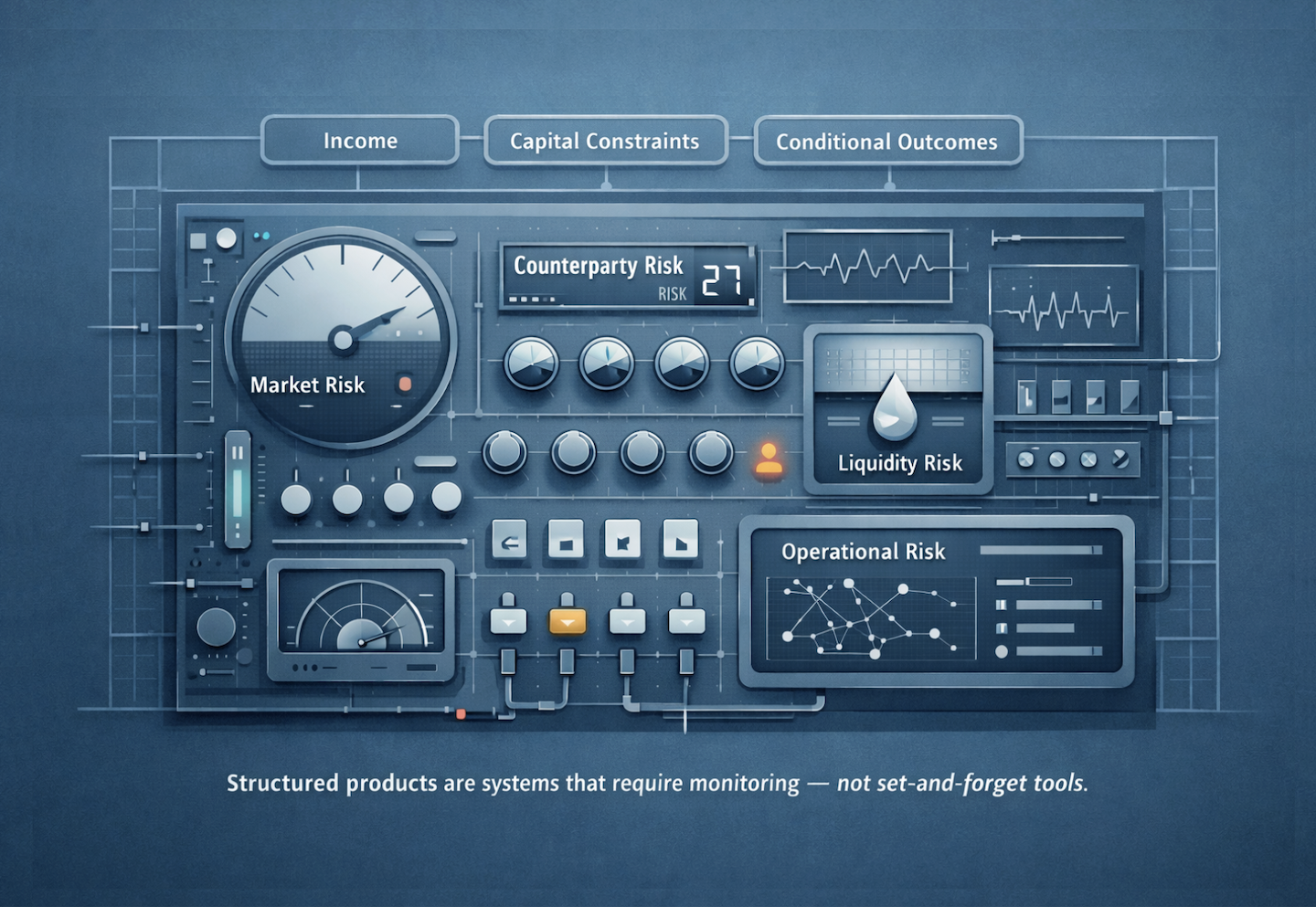
Structured treasury approaches should be treated as systems that require monitoring rather than passive instruments. Their conditional outcomes, layered risks, and operational dependencies demand careful understanding before any discussion of implementation.
A governance-first approach places education before execution, clarity before complexity, and process before outcomes. In crypto-native treasuries, where volatility and scrutiny are structural features, this approach is essential.
Disclaimer
This article is for informational purposes only and does not constitute investment advice, an offer, or a solicitation. Structured products involve complex risks and may not be suitable for all investors. Any decision requires independent legal, tax, and risk assessment.
Published on 19.01.2026
Adrien Bertholom
Others articles

Thought leadership
Why transparency reveals the real strength of crypto liquidity.

Thought leadership
How large capital interacts with liquidity, inventory and execution in crypto markets.