
Beyond Structured Treasury: How On-Chain Financial Infrastructure Reshapes Foundation Risk
Programmable infrastructure is redefining digital asset treasury risk.
In our previous article, Structured Product in Digital Assets : A Governance-first Overview for foundations, we examined how conditional payoff structures can reshape treasury risk when holdings are concentrated, volatile, or politically sensitive. That discussion focused on instrument design: how structured overlays modify exposure and redistribute downside risk.
The next phase of digital asset treasury evolution is no longer centred on payoff engineering.
It is centred on infrastructure.
Across stablecoins, tokenized funds, staking ETPs, corporate crypto reserves, and emerging Digital Asset Treasury (DAT) vehicles, scrutiny has shifted away from yield optimisation and toward architectural integrity. Redemption mechanics, reserve segregation, custody design, oracle sourcing, and upgrade authority are now core variables in treasury evaluation.
Structured products alter payoff distributions.
Programmable infrastructure alters the conditions under which those payoffs are realised.
That distinction defines resilience.
From Instrument to System
Traditional treasury products operate within layered institutional frameworks. Subscription, custody, valuation, clearing, and settlement are distributed across regulated intermediaries. Legal documentation defines rights. Administrative processes introduce time buffers that absorb operational error and slow the transmission of stress.
Risk exists in these systems, but it is mediated.
On-chain treasury vehicles reorganize these layers into programmable logic. Minting and redemption may be encoded directly in smart contracts. Settlement becomes atomic rather than deferred. Collateralization and reserve balances may be observable in real time. Governance permissions can be embedded within contract architecture.
Efficiency increases.
Intermediation decreases.
And risk migrates.
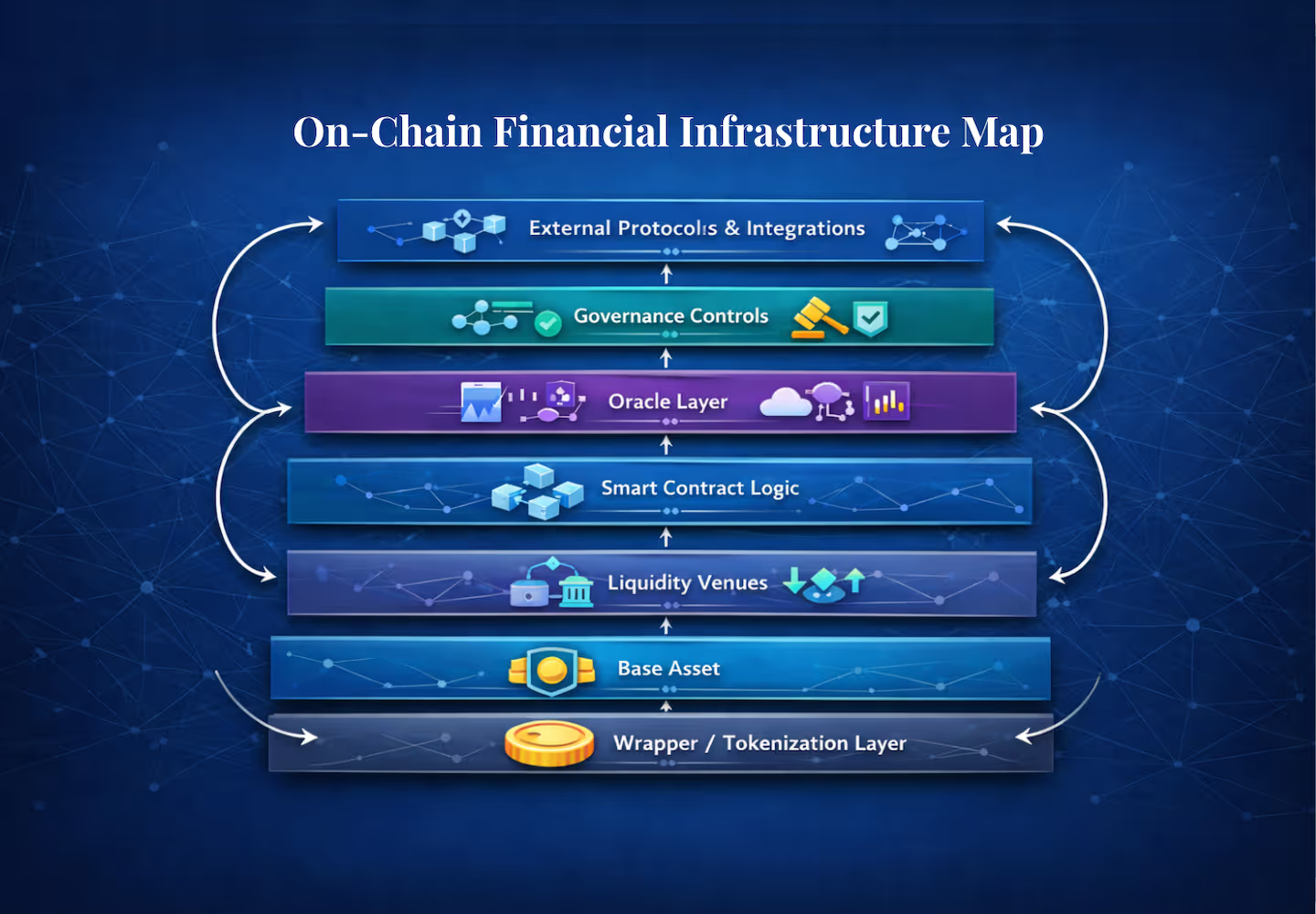
Instead of relying primarily on institutional buffers, treasury structures depend on code correctness, oracle integrity, liquidity depth, governance configuration, and the integrity of connected protocols. The technical stack becomes inseparable from the financial instrument.
Treasury, in this context, is no longer simply an allocation decision. It is an operational system.
Structural Shifts That Redefine Assumptions
Three features of programmable finance materially reshape treasury design.
Settlement Finality
On-chain transactions settle irreversibly once executed. There are no reconciliation windows or administrative reversals. Liquidity timelines compress from days to minutes, making execution design and operational precision part of the risk framework.
Continuous Transparency
Where reserves and collateral are visible on-chain, treasury becomes a continuously observable system. Transparency strengthens credibility but removes opacity buffers. During volatility, balance changes and collateral ratios are visible to all participants simultaneously.
Composability
Composability On-chain assets can, in principle, interact with other protocols. A transferable treasury token may be integrated into lending markets, paired in liquidity pools, or incorporated into structured yield strategies (provided it is supported by those platforms).What matters is that once a treasury asset is transferable and programmable, the potential for inter-protocol interaction exists. That potential expands the structural risk surface, even if exercised selectively.
Composability introduces optionality, which in turn reshapes how risk can propagate across connected layers.
The Expanded Risk Surface
Programmable infrastructure alters where risk resides.
Smart contract design replaces elements of contractual enforceability. Oracle dependencies influence valuation integrity. Liquidity depth becomes a structural assumption rather than a secondary consideration. Cross-protocol connections, where permitted, create pathways through which stress can propagate.
These characteristics do not inherently weaken digital asset treasury vehicles. They change their behavioural profile.
The relevant question for issuers and oversight bodies is no longer limited to expected returns or volatility ranges. It is how the system is constructed, where dependencies lie, and how those dependencies interact.
Infrastructure has become the primary determinant of treasury resilience.
Conclusion
Digital asset treasury vehicles are no longer defined solely by their payoff structures. They are defined by the systems within which those payoffs are generated, settled, and observed.
Settlement compression, transparency, and conditional composability transform treasury from a passive balance sheet function into a programmable architecture.
The structural shift is already underway.
Institutions that recognise treasury as infrastructure — rather than merely as instrument design — will be better positioned to evaluate resilience in an increasingly interconnected financial environment.
Published on 02.03.2026
Taym Moustapha
Others articles

Thought leadership
Why bear markets expose fragile liquidity and broken market structure in crypto.
Thought leadership
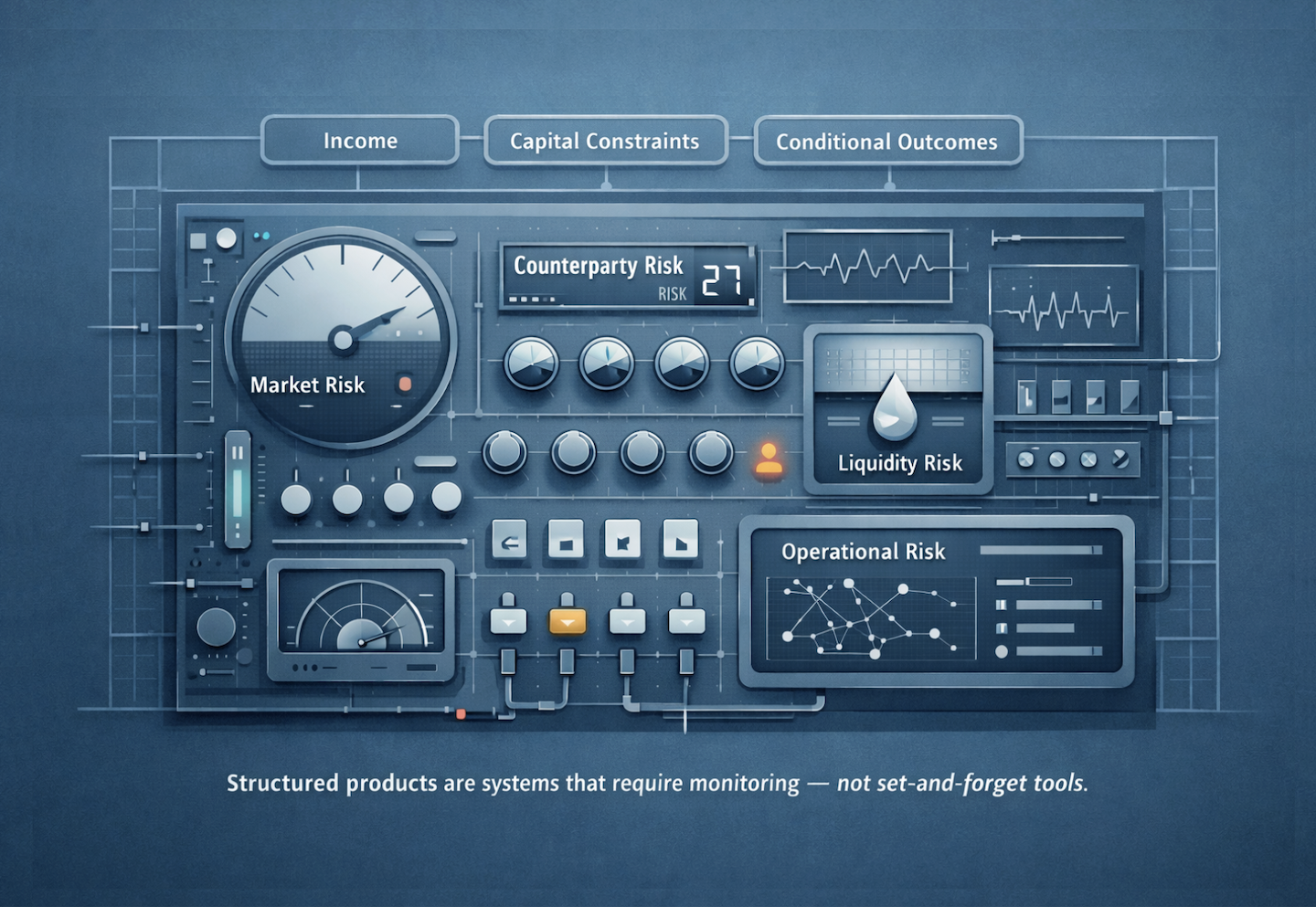
A governance-first overview of structured products in digital asset markets for foundations.