In Conversation With Dipak Shah, Head of OTC Trading at Portofino
Dipak Shah on crypto OTC trends and why he joined Portofino from traditional finance.
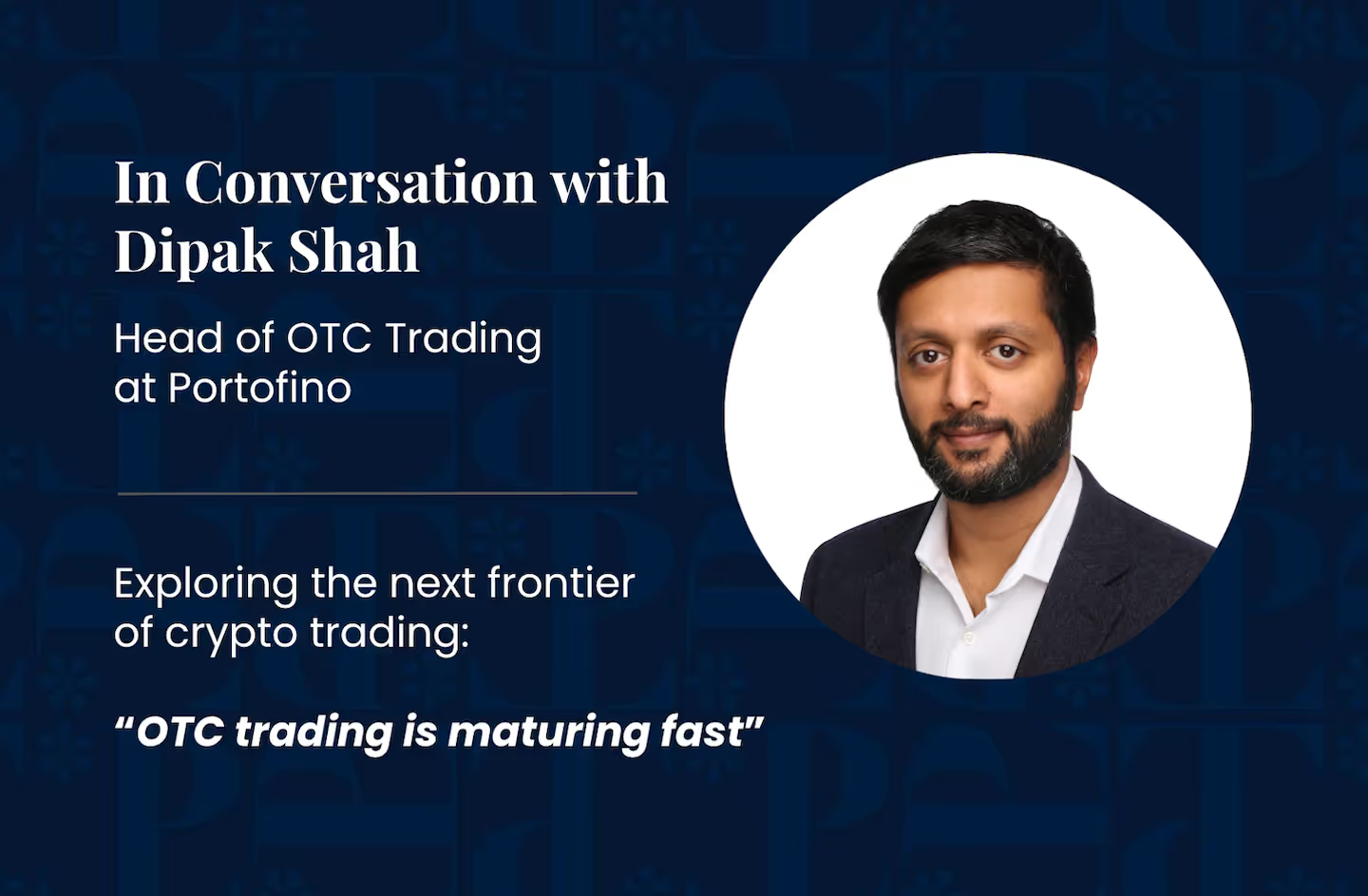
Dipak joined Portofino Technologies six months ago after a long career in traditional finance.
Q: Dipak, what inspired your move into crypto, and why Portofino?
A: After more than 15 years in FX options trading across institutions like Nomura, Citi, and Goldman Sachs, I was drawn to the pace of innovation in digital assets. The crypto market offers a unique opportunity to apply the tools of traditional finance in a rapidly evolving space. What stood out about Portofino was its proprietary technology, its agility as a firm, and its vision of becoming a premier liquidity provider across both centralised and OTC markets. Joining as Head of OTC Trading was a natural step—to bring my experience into a new frontier and help shape a high-impact trading business.
Q: What’s your focus at Portofino, and how is the OTC business evolving under your leadership?
A: Portofino is, at its core, a technology-driven trading firm. My focus is on leveraging our tech stack to create a seamless and efficient OTC experience—where clients can rely on us to price liquidity and absorb risk as market makers. Our goal is to bring the precision and professionalism of traditional trading desks to the digital asset space, while maintaining the flexibility and responsiveness that crypto clients value.
Q: You’ve been observing key shifts in the crypto market recently. What are the most notable trends you’re seeing in OTC flow?
A: OTC Trading is maturing fast, a few trends stand out.
First, we’re seeing a significant uptick in demand for stablecoins—particularly USDT and USDC. This reflects a growing desire for exposure to digital money without the volatility of other assets, and increasing confidence in stablecoins as tools for settlement and value storage.
Second, altcoins have rallied strongly following Trump’s recent softening on tariffs. A lot of capital that had been sitting on the sidelines amid geopolitical uncertainty has started to flow back into the market, driving appetite for directional trades and cross-asset rotation.
Third, we’re closely watching the potential lifting of the ban on crypto ETNs in the UK. If it goes ahead, we expect to see higher volumes in GBP pairs—especially into alts. It’s a gateway for more institutional capital, and we’re already seeing positive momentum on the OTC desk.
Q: How does Portofino differentiate itself in the OTC market compared to traditional players or other crypto-native desks?
A: Our edge lies in three key areas: speed, our ability to price and manage risk internally, and our capacity to serve multiple clients at scale. Our proprietary trading infrastructure allows us to quote tight and fast across a wide range of assets, 24/7. We combine systematic strategies with trader expertise to deliver intelligent pricing and risk decisions. And finally, we offer high-touch service. Crypto remains a relationship-driven market, and we work closely with clients to structure trades tailored to their needs—be it block liquidity, cross-asset risk transfer, or discreet execution.
Q: Where do you see the biggest opportunities in OTC crypto over the next 6 to 12 months?
A: I expect continued institutional adoption, especially as regulatory clarity is likely to improve in Europe and Asia, much like what we’ve seen in the US. As large players seek efficient ways to enter and exit markets without impacting price, OTC trading will become increasingly important. We also anticipate more token issuers and protocols turning to strategic liquidity partners—particularly for token unlocks, treasury management, and staking-related flows. Portofino is well-positioned to be a trusted partner in that ecosystem.
Q: Finally, what advice would you give to traditional finance professionals considering a move into crypto trading?
A: Stay humble and curious. Crypto is unlike any market I’ve traded—its speed, its community dynamics, and its technological infrastructure are unique. That said, the core principles—risk management, pricing discipline, and client service—still hold true. If you’re open to learning and want to help shape the future of financial markets, now is the perfect time to make the move.
Thank you, Dipak. Exciting times ahead.
A: Absolutely—thank you.
Published on 06.11.2025
Written by
Carole Laizet
Others articles
See all

Opinion
Market Integrity: Crypto's Next Challenge
Why market integrity, not technology, will shape crypto's next chapter.

Opinion
Quantum Computing Won’t Kill Crypto, But It Will Expose Who Was Never Ready
Quantum computing will test crypto institutions long before it breaks cryptography.