Market Integrity: Crypto's Next Challenge
Why market integrity, not technology, will shape crypto's next chapter.

Crypto promised to replace trust with transparency. In many ways, it succeeded. Never before has so much financial information been available to the public. Every transaction is permanently recorded on an immutable blockchain. Wallet balances can be monitored in real time. Sophisticated analytics platforms can reconstruct flows across thousands of addresses, identify clusters of related wallets and trace billions of dollars moving across public networks with a level of precision that traditional finance could only dream of a decade ago. Public blockchains have become one of the most transparent financial infrastructures ever created.
And yet, despite this unprecedented transparency, some of the most important questions investors ask remain remarkably difficult to answer. How much of a token's supply is genuinely available to trade? Who ultimately controls that supply? Are prices being driven by fundamental demand, leveraged speculation or increasingly illiquid order books? Can a market worth several billion dollars still be moved by surprisingly little capital?
For institutional investors, these are not academic questions; they sit at the heart of market confidence. For most of the past decade, crypto has been judged by the speed of its innovation. Faster blockchains. More efficient consensus mechanisms. Lower transaction fees. Smarter smart contracts. Each cycle has been defined by a new technological breakthrough that promised to reshape finance. That era is beginning to mature. Today, some of the largest barriers to institutional adoption are no longer technological. Pension funds are not delaying investment because blockchains settle in ten seconds instead of two. Asset managers are not hesitating because transaction fees remain a fraction of a cent too high. Increasingly, they are asking a far more fundamental question: can these markets be trusted?
Trust is an unusual word in crypto. It rarely appears in discussions dominated by throughput, decentralisation, total value locked or market capitalisation. Yet throughout financial history, trust has always been the invisible foundation upon which successful markets were built. Technology can make markets faster. Innovation can make them larger. Only market integrity makes them investable.
Bull markets have a habit of hiding this reality. Abundant liquidity masks structural weaknesses. Rising prices make ownership concentration appear irrelevant. Deep speculative demand absorbs leverage that would otherwise destabilise markets. When almost every asset is appreciating, few participants stop to question whether prices genuinely reflect supply and demand.
Bear markets tell a different story. Volumes fall. Liquidity retreats. Market makers become more selective. Retail participation fades. Suddenly, markets begin reacting to forces that remained largely invisible during the previous cycle. The distinction between circulating supply and tradable supply becomes meaningful. Ownership concentration starts to matter. Derivatives begin influencing price discovery as much as, or sometimes more than, spot markets. Markets worth billions of dollars can, in some circumstances, become surprisingly sensitive to relatively modest flows of capital. It is during these periods that the quality of a market's structure is truly tested.
At first glance, this appears to be a story about market structure. In reality, it is a story about market integrity. Crypto is entering a new phase of its evolution. The industry's next challenge is structural, not technological. As digital assets continue to mature and institutional participation grows, market integrity will become one of the defining characteristics of successful crypto ecosystems. To understand why, we must look beyond market capitalisation and examine the mechanisms that truly determine how markets behave under stress: effective float, ownership concentration, liquidity, leverage, derivatives, price discovery and transparency. The next decade of crypto will be shaped by the markets that earn investors' trust: markets where prices genuinely reflect supply and demand, where liquidity remains resilient under stress, where transparency extends beyond the blockchain itself and where innovation is matched by integrity.
That evolution has already begun.
When Bull Markets Hide the Truth
One of the defining characteristics of financial markets is that prices rarely tell the whole story. A rising price does not necessarily indicate a healthy market, just as a falling price does not necessarily reflect deteriorating fundamentals. Understanding why requires looking beyond the price itself and asking a more fundamental question: how is this asset actually valued?
Traditional financial assets benefit from valuation frameworks that have evolved over decades, sometimes centuries. Equity analysts may disagree on growth assumptions or discount rates, but they generally rely on the same underlying principle: a company's value ultimately reflects the present value of its expected future cash flows. Bond prices are anchored by contractual repayments. Real estate derives value from rental income and comparable transactions. Even commodities tend to gravitate around production costs, inventories and physical supply constraints. Markets may temporarily diverge from these anchors, but investors have a broadly accepted framework against which prices can eventually be assessed.
Crypto is a much younger asset class and its valuation frameworks are still evolving. While an increasing number of protocols now generate revenues, staking yields or network fees, there is still no broadly accepted methodology for valuing many digital assets. Investors may assess the same token through network activity, adoption metrics, fee generation, token scarcity or entirely different assumptions. As a result, market structure plays a far greater role in price formation than it does in more mature asset classes. When fundamental valuation anchors are weaker or less universally accepted, liquidity, ownership concentration, effective float and leverage do not simply influence prices; they become integral to the price discovery process itself.
This distinction becomes particularly important during different phases of the market cycle.
During bull markets, liquidity is abundant. Retail participation accelerates, institutional flows increase, speculative capital rotates rapidly between narratives and market makers are willing to warehouse larger inventories because the probability of finding the opposite side of a trade is high. Order books deepen, spreads tighten and even relatively large transactions can be absorbed with limited market impact. In this environment, markets appear healthy almost by default. Strong liquidity smooths over many structural imperfections that would otherwise become immediately visible. That abundance of liquidity creates an illusion of robustness. A token may have a highly concentrated ownership structure, but continuous buying pressure prevents investors from questioning who actually controls the supply. Another project may rely on an unusually small tradable float, yet persistent inflows create the impression of deep and resilient liquidity. Derivatives markets can expand rapidly while leverage quietly accumulates beneath the surface, largely unnoticed because every liquidation is absorbed by fresh demand. As long as capital continues flowing into the market, weaknesses in market structure remain hidden.
Bear markets remove that safety net. As optimism fades, trading activity contracts and speculative capital becomes increasingly selective. Retail participation declines, market makers reduce inventory and investors become less willing to provide liquidity during periods of uncertainty. Order books become thinner, spreads widen and price impact increases. Trades that would barely have registered during a bull market can suddenly move prices by several percentage points. Liquidity no longer masks structural weaknesses; it exposes them. This fundamentally changes the way markets behave. Ownership concentration begins to matter because relatively few holders may control a significant proportion of the available supply. The distinction between circulating supply and genuinely tradable supply becomes increasingly important. Derivatives markets, particularly perpetual futures, may exert greater influence over short-term price movements than spot trading itself. Markets worth billions of dollars can become surprisingly sensitive to relatively modest flows of capital because there are simply fewer participants available to absorb them.
Bear markets are often described as a test of projects. In reality, they are also a test of markets. They reveal whether prices continue to reflect genuine supply and demand when liquidity disappears, or whether they become increasingly driven by concentrated ownership, leverage and fragile trading conditions. It is during these periods that market integrity stops being an abstract concept and becomes a defining characteristic of a mature financial market. Understanding why this happens requires looking beyond the metrics that dominate most market commentary. Market capitalisation, circulating supply and trading volume remain useful reference points, but they rarely tell the whole story. To understand how a crypto market is likely to behave under stress, investors must first understand the forces operating beneath the surface.
👉 Bull markets reward innovation. Bear markets reveal market structure.
Why Billion-Dollar Markets Can Behave Like Small Ones
One of the most surprising characteristics of crypto markets is that size and resilience are not always the same thing.
Market capitalisation creates an impression of depth. A digital asset valued at several billion dollars appears, almost intuitively, to require billions of dollars of buying or selling pressure before its price can move materially. In reality, market capitalisation measures only the value of the last traded token multiplied by the reported circulating supply. It says remarkably little about how much capital would actually be required to move the market.
This distinction is fundamental.
Two digital assets may each be valued at $5 billion. On paper, they appear almost identical. Both report similar market capitalisations, comparable daily trading volumes and seemingly healthy liquidity. Yet one can absorb institutional-sized trades with relatively little market impact, while the other experiences double-digit price swings following transactions worth only a few million dollars.
The explanation rarely lies in market capitalisation itself.
Instead, it lies beneath the surface, in the way supply is distributed and how much of that supply can realistically participate in the market.
Most investors are familiar with circulating supply. Data providers calculate market capitalisation by multiplying the current price by the number of tokens considered to be circulating. This metric is useful, but it implicitly assumes that every circulating token is equally available for trading.
In practice, this assumption is rarely true. Some circulating tokens are held by long-term investors with little intention of selling. Others are controlled by foundations, treasuries or strategic investors. Some are held by market makers as inventory to support liquidity rather than to express investment views. Others have been distributed through private OTC transactions and remain economically unavailable because they are subject to financing arrangements, hedging strategies or contractual restrictions. In some cases, tokens may be frozen following legal disputes or technical incidents, while others are simply lost because the private keys controlling them are no longer accessible.
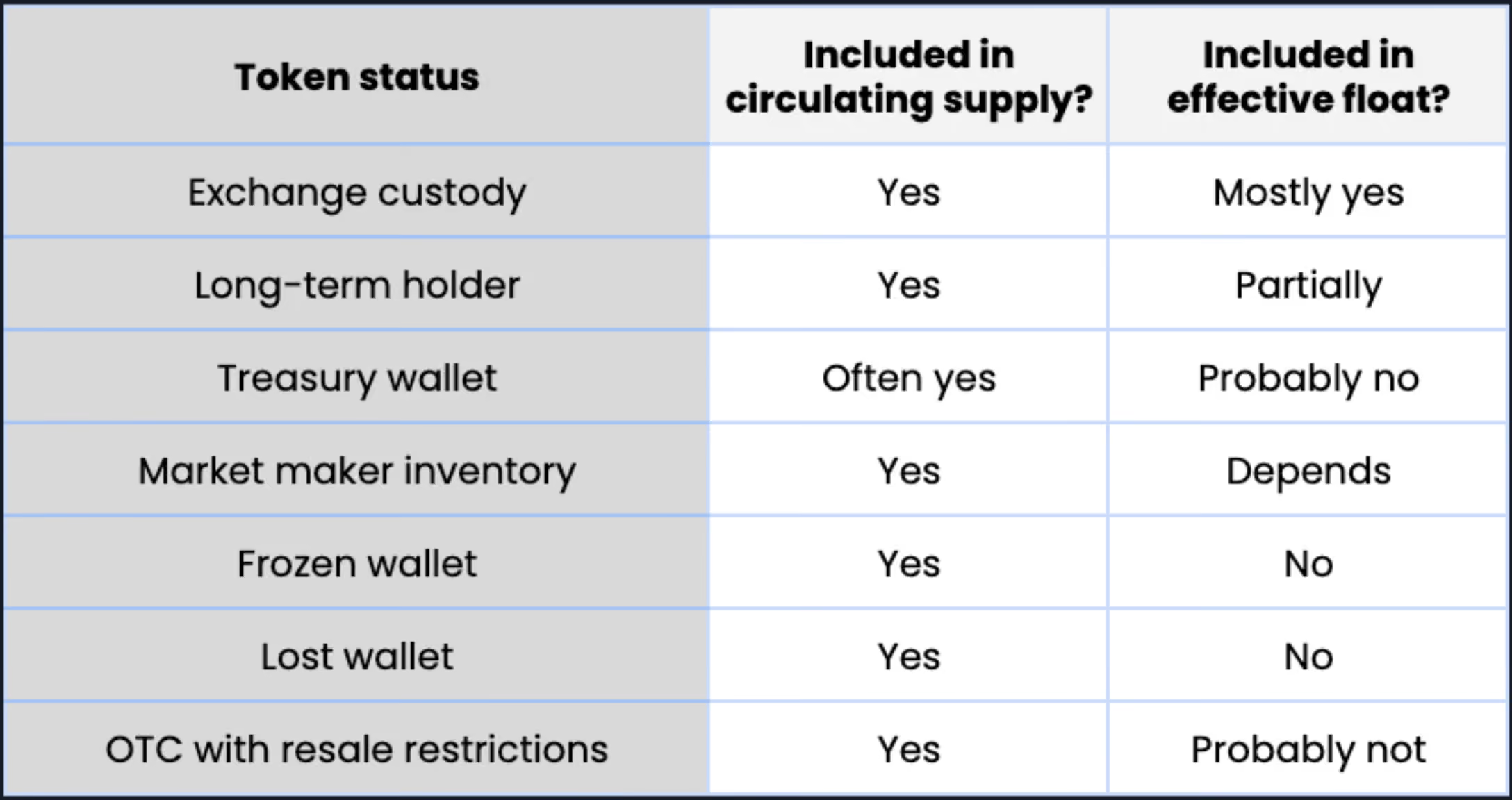
The distinction between circulating supply and effective float is therefore not binary but a continuum. Every token may technically be circulating, yet not every token is equally capable of participating in price discovery. Effective float is our estimate of the supply that can realistically absorb buying and selling pressure under normal market conditions.
This distinction becomes particularly important during periods of market stress. When liquidity is abundant, differences between circulating supply and effective float may have relatively little influence on day-to-day trading. During bear markets, however, the opposite is true. As volumes contract and fewer participants are willing to provide liquidity, a shrinking effective float means progressively smaller amounts of capital are required to influence prices.
Effective float alone, however, rarely tells the whole story.
The distribution of that float matters just as much.
A market where ownership is dispersed across hundreds of thousands of independent participants behaves very differently from one where a significant proportion of the available supply is concentrated among a small number of entities. Two projects may report identical circulating supplies, yet exhibit completely different market dynamics because ownership is distributed differently. Concentrated ownership reduces the amount of supply actively competing in the market and increases the influence that relatively few participants may have on price formation.
Liquidity adds another dimension.
Reported trading volume is often treated as a proxy for market quality, yet volume alone says remarkably little about execution conditions. A token may record hundreds of millions of dollars in daily turnover while maintaining remarkably shallow order books. Another may trade significantly lower daily volumes yet offer substantially deeper liquidity around the current market price. What ultimately matters for investors is not how much traded yesterday, but how much capital can be executed today without materially moving the market.
These characteristics rarely operate independently. They reinforce one another.
A market with a small effective float, concentrated ownership and shallow liquidity may appear perfectly healthy during a period of strong demand. Yet once liquidity begins to retreat, each weakness amplifies the others. Price becomes increasingly sensitive to relatively modest flows. Slippage rises. Volatility increases. Market participants begin reacting to market structure rather than fundamentals. What initially appeared to be a large and liquid market gradually reveals itself to be considerably more fragile than its market capitalisation suggested.
Understanding this interaction is essential because these characteristics determine not only how prices move, but also how markets respond when leverage enters the equation.
Effective float provides a far more realistic view of a market than circulating supply, but it is only the beginning. A market's resilience also depends on who controls that supply, how easily it can be traded, how leverage influences price discovery and how much of this process remains visible to investors. These dimensions do not operate independently. They reinforce one another, shaping the way markets behave under both normal conditions and periods of stress. Understanding market structure therefore requires looking beyond effective float. The following sections examine these additional dimensions and explain why they matter for institutional investors.
👉 Market capitalisation measures value. Effective float measures resilience.
Who Controls the Market?
Knowing how much supply is available to trade is only half the equation. Equally important is understanding who controls that supply.
Two markets may report similar circulating supplies and even comparable effective floats, yet behave very differently simply because ownership is distributed differently. A market where tradable supply is dispersed across tens of thousands of independent investors is generally more resilient than one where a significant proportion is concentrated in the hands of a few entities. The amount of supply may be identical; the market dynamics are not.
Ownership concentration is one of the clearest indicators of structural fragility. When a relatively small number of wallets control a large proportion of the effective float, those participants inevitably exert greater influence over price formation. This does not imply malicious intent. Founding teams, foundations, early investors and strategic partners often hold substantial allocations for perfectly legitimate reasons. Long-term holders may also contribute to concentration without actively participating in the market. Nevertheless, concentrated ownership reduces the diversity of independent decision-makers and increases the market's sensitivity to the actions of a relatively small number of participants.
This distinction becomes particularly important during periods of market stress. In liquid and optimistic markets, concentrated ownership may remain largely invisible as continuous buying interest absorbs available supply. During bear markets, however, when liquidity becomes scarcer and fewer participants are willing to provide capital, the actions of a handful of large holders can have a disproportionate impact on prices. A single large sale, an unexpected transfer to an exchange, or the perception that a major holder may reduce exposure can quickly alter market sentiment.
Measuring ownership concentration requires looking beyond the headline holder count. A token may have hundreds of thousands of wallets while the overwhelming majority of supply remains controlled by only a few addresses. Analysts therefore focus on metrics such as the proportion of supply held by the top 10, top 20 or top 100 wallets, while also identifying the nature of those holders. Foundation treasuries, exchange custody wallets, bridge contracts, staking contracts and market maker inventories each play very different roles and should not be interpreted in the same way.
Fortunately, much of this information is publicly accessible. Blockchain explorers such as Etherscan, Solscan and Tronscan provide holder distributions for individual networks. Specialist platforms including Arkham, Bubblemaps, Nansen and GeckoTerminal go further by attributing wallets, identifying clusters of related addresses and visualising relationships that would otherwise remain difficult to detect. These tools allow investors to move beyond simple holder counts and begin assessing who may ultimately control the available supply.
Imagine you come across a token that has appreciated more than one hundred-fold within a matter of weeks. Its market capitalisation now exceeds several billion dollars. Trading volumes appear healthy, social media activity is booming and the project has become one of the best-performing assets of the year. Where do you begin?
The first instinct may be to read the white paper, study the tokenomics or analyse protocol revenues. Those are all important, but they do not answer a more immediate question: who actually owns this market?
Unlike traditional financial markets, public blockchains allow anyone to inspect the ownership structure of a digital asset. Blockchain explorers such as Etherscan or Solscan reveal the largest holders, while specialist platforms including Arkham, Bubblemaps and Nansen attempt to identify entities behind those wallets, group related addresses and visualise the movement of funds across the network. Rather than relying solely on financial statements or regulatory filings, crypto analysts can literally follow the money.
Suppose our investigation reveals that the top twenty wallets control almost the entire supply. At first glance, this may not appear unusual. Treasury wallets, vesting contracts, bridge contracts, exchange custody wallets and staking contracts can all legitimately hold significant balances. The real challenge lies in determining which wallets represent genuinely independent market participants and which are ultimately controlled by the same entity.
This is where on-chain analysis becomes both powerful and imperfect.
Wallet clustering can reveal surprisingly rich information. Addresses funded by the same wallet, created simultaneously, interacting with the same counterparties or repeatedly transferring assets between one another often point towards common ownership or coordinated behaviour. Analysts can reconstruct these relationships visually, identify unexpected patterns and sometimes uncover concentrations that are far greater than simple holder rankings would suggest.
Yet the blockchain does not tell the whole story. Once tokens enter centralised exchanges, they disappear behind omnibus custody wallets. A transfer into an exchange may represent thousands of independent investors, a single institutional client or inventory controlled by the exchange itself. Similarly, private OTC transactions often leave little visible evidence beyond the initial transfer, making it difficult to determine whether ownership has genuinely diversified or merely changed form. Blockchain analytics can reconstruct an extraordinary amount of market activity, but they inevitably lose visibility whenever assets move behind the walls of centralised venues.
This distinction is crucial. A market may appear widely distributed because tokens have left the original treasury wallets, while in reality ownership remains concentrated through exchange custody, private financing arrangements or coordinated participants that are no longer distinguishable on-chain. Transparency is one of crypto's greatest innovations, but it is not absolute. For investors, the objective is therefore not to identify every beneficial owner with certainty. That is rarely possible. Instead, the goal is to assess whether ownership appears sufficiently diversified to support healthy price discovery, or whether a relatively small number of participants may still exert disproportionate influence over the market.
Ownership concentration should never be interpreted in isolation. A high concentration ratio does not automatically imply manipulation, just as a dispersed holder base does not guarantee a healthy market. Context matters. Investors should pay particular attention to unexplained wallet clusters, groups of addresses funded simultaneously, large transfers between related wallets, sudden movements towards exchange deposit addresses or significant changes in concentration over relatively short periods. Individually, these signals may be innocuous. Together, they can reveal structural changes in market behaviour long before they become visible in the price itself.
Ultimately, ownership concentration is not a measure of value. It is a measure of influence. It helps answer one of the most important questions an investor can ask: if market conditions deteriorate tomorrow, how many independent participants are truly determining the price?
👉 Following the money explains who controls the market. Following the price rarely does.
When Shorting Stops Working
One of the fundamental principles of efficient financial markets is that investors should be able to express both positive and negative views. Buyers who believe an asset is undervalued provide upward pressure on prices. Sellers who believe it is overvalued provide downward pressure. The constant interaction between these opposing forces is what allows markets to discover fair value.
Perpetual futures were designed to reinforce this process rather than distort it. Unlike traditional futures, perpetual contracts have no expiry date. To ensure that perpetual prices remain close to the underlying spot market, exchanges introduced a funding mechanism. At regular intervals, one side of the market compensates the other. When perpetual contracts trade above the spot price, funding becomes positive and long positions pay short positions. When perpetuals trade below spot, funding turns negative and short positions compensate longs. In theory, this simple mechanism encourages traders to take the opposite side whenever prices diverge too far from equilibrium, gradually pulling perpetual and spot markets back together.
Most of the time, it works remarkably well. Under normal market conditions, funding rates remain relatively small and fluctuate around zero. Temporary imbalances between buyers and sellers are quickly corrected as arbitrageurs step in to capture the funding differential. The mechanism rewards those willing to restore balance and discourages one-sided positioning.
Extreme market conditions tell a different story. When a token experiences sustained buying pressure while its effective float remains limited, traders seeking to express a bearish view naturally increase their short exposure through perpetual futures. As short interest builds, funding rates paid by long positions initially rise, attracting additional short sellers who are compensated for taking the opposite side. Up to this point, the mechanism functions exactly as intended.
The problem arises when funding becomes so extreme that holding a short position becomes economically prohibitive. Funding rates are typically quoted every eight hours, but during periods of exceptional market stress they can reach levels that imply annualised costs of several hundred, or even several thousand, percent. More importantly, these costs compound over time. A trader may correctly identify that a token is significantly overvalued, yet still be forced to close the position simply because the cumulative funding payments exceed the potential profit from being right. In extreme cases, the cost of maintaining the short position can become larger than the initial exposure itself. Markets cannot be considered fully efficient if one side of price discovery becomes economically impossible to express.
Ironically, the very mechanism designed to restore equilibrium can begin preventing it. As economically rational short sellers leave the market, fewer participants remain willing to challenge elevated prices. Price discovery becomes increasingly one-sided. Relatively modest buying pressure can trigger further short liquidations, forcing bearish traders to buy back positions and pushing prices even higher. Positive funding attracts fewer new shorts, existing shorts reduce exposure and the feedback loop reinforces itself.
This does not imply that every period of elevated funding reflects manipulation. Bull markets naturally generate optimism, leverage and sustained demand for long exposure. However, unusually persistent or extreme funding rates should prompt investors to ask additional questions. Is genuine spot demand driving the market, or are derivatives beginning to dominate price discovery? Is sufficient effective float available to support this level of leverage? Could short sellers be exiting not because they believe the market is fairly valued, but because maintaining their positions has become uneconomic?
Funding therefore provides far more than a measure of market sentiment. It offers insight into the balance of power between buyers and sellers. When funding remains close to equilibrium, the market is generally functioning as intended. When it becomes persistently extreme, it may indicate that one side of the market is gradually losing its ability to participate in price discovery.
Efficient markets require both buyers and sellers. If buyers disappear, prices fall. If sellers disappear because shorting becomes prohibitively expensive, prices may continue to rise despite weakening fundamentals. In both cases, price discovery deteriorates.
Like every market structure indicator, funding should never be interpreted in isolation. Combined with effective float, ownership concentration and open interest, it becomes a powerful tool for understanding whether prices continue to reflect healthy competition between buyers and sellers or whether structural imbalances are beginning to dominate.
👉 Funding was designed to restore equilibrium. Under extreme conditions, it can prevent equilibrium.
The Limits of Transparency
The previous chapters may give the impression that crypto markets are almost perfectly observable. After all, blockchains record every transaction, wallet balances are public, funding rates are published in real time and sophisticated analytics platforms reconstruct relationships between millions of addresses. Compared with traditional financial markets, this level of transparency is extraordinary. Yet every investigation eventually reaches the same point. The trail goes cold.
Blockchain analytics can reveal an astonishing amount of information. Platforms such as Arkham, Bubblemaps, Nansen, Chainalysis and TRM Labs allow analysts to identify wallet clusters, follow treasury movements, monitor large transfers, detect exchange deposits and reconstruct the relationships between thousands of addresses. In many cases, they can reveal market dynamics that would remain completely invisible in traditional finance.
But blockchain transparency has natural limits. The moment tokens enter a centralised exchange, visibility changes fundamentally. On-chain, an analyst can see that assets have been transferred into a Binance, Bybit or OKX deposit wallet. What happens next is largely hidden from public view. Were the tokens immediately sold? Are they still sitting in custody? Have they been lent to another participant? Are they being used as collateral? Have they been transferred internally between institutional clients or allocated to a market maker supporting liquidity? From the blockchain alone, none of these questions can be answered with certainty.
The same limitation applies to over-the-counter transactions. A large OTC transfer is usually visible on-chain, but the commercial agreement behind that transfer is not. Tokens may have been sold at a significant discount, pledged as collateral, loaned to a liquidity provider or exchanged under contractual restrictions that prevent immediate resale. Two identical blockchain transactions may therefore represent completely different economic realities. The blockchain records ownership transfers; it does not record the agreements that govern them.
This distinction becomes particularly important when analysing ownership concentration and effective float. A token may appear to have become widely distributed simply because treasury wallets have transferred assets to numerous exchange deposit addresses or newly created wallets. In reality, effective control may have changed very little. Ownership may simply have moved behind custodial structures or contractual arrangements that are no longer visible on-chain. Apparent decentralisation is not always genuine decentralisation.
This is not a criticism of blockchain transparency. On the contrary, public blockchains have transformed market analysis by making vast amounts of information freely accessible to anyone with the appropriate tools and expertise. The issue is simply that transparency is not absolute. Every financial system contains layers of information that remain private, and crypto is no exception. Blockchain analytics dramatically expands what investors can observe, but it cannot reveal information that exists only inside exchanges, private contracts or bilateral commercial relationships.
For institutional investors, recognising these limits is just as important as understanding the data itself. Effective float, ownership concentration, funding rates and liquidity are all powerful indicators, but none should be interpreted as precise measurements. They are pieces of evidence that, when considered together, help build a probabilistic view of how a market functions. Good market analysis is therefore less about finding certainty than about reducing uncertainty.
Ironically, this brings us back to where the paper began. Crypto succeeded in making financial infrastructure dramatically more transparent than anything that came before it. But transparency alone cannot eliminate uncertainty. Markets still require robust price discovery, effective surveillance, meaningful disclosure and confidence that prices reflect genuine competition between buyers and sellers.
Transparency made better markets possible. Market integrity is what will make them trusted.
👉 A transparent blockchain does not automatically create a transparent market.
Integrity: What Wall Street Learned
Every major financial market has experienced periods during which information was unevenly distributed, surveillance was limited and prices could be influenced by relatively small groups of participants. Long before electronic trading, financial markets relied almost entirely on human interaction. Traders negotiated face-to-face on exchange floors, deals were agreed verbally and much of the market's functioning depended on reputation rather than technology. There were few electronic records, limited audit trails and relatively little ability to reconstruct events after they occurred. Ironically, those markets placed enormous value on a word that is rarely heard in crypto today: integrity.
Integrity was not simply an ethical principle. It was a commercial necessity. Markets could only function if participants believed that prices reflected genuine competition rather than coordinated behaviour. Reputation mattered because trust was the foundation upon which every transaction depended.
As financial markets grew, however, reputation alone became insufficient. Increasing trading volumes, greater participation and technological innovation created opportunities for increasingly sophisticated forms of market abuse. Insider dealing, wash trading, spoofing, market corners and other manipulative practices did not disappear as markets modernised; they became more complex. The response was to strengthen the institutions that underpin financial markets.
Over several decades, equity markets gradually introduced many of the mechanisms investors now take for granted. Continuous market surveillance, audit trails, best execution requirements, disclosure obligations, position reporting, market abuse regulations, circuit breakers and ever more sophisticated exchange monitoring all emerged for the same reason: to strengthen confidence in price discovery. None of these measures eliminated manipulation entirely, but together they significantly increased the cost, complexity and likelihood of detection. The result was markets that became progressively more resilient and more trusted.
Institutional investors understand that manipulation can never be eradicated completely. Every market occasionally experiences fraud, insider trading or attempts to influence prices. What matters is not whether misconduct exists, but whether market structures, exchanges and regulators are capable of detecting it, investigating it and responding effectively. Confidence comes from the belief that markets are fundamentally fair and that abuse carries meaningful consequences.
Crypto now finds itself at a remarkably similar point in its evolution. The industry has largely solved many of the technological challenges that dominated its first decade. Settlement is measured in seconds rather than days. Assets can be transferred globally without traditional intermediaries. Smart contracts automate processes that once required extensive operational infrastructure. These technological achievements have laid the foundations for the next stage of crypto's evolution: building stronger, more resilient and more trusted markets. That does not necessarily require copying traditional finance. Crypto possesses advantages that previous generations of financial markets never had: public blockchains, programmable assets and unprecedented on-chain transparency. These innovations create opportunities to build market surveillance and disclosure standards that are, in some respects, more effective than those of traditional finance.
At the same time, the industry faces challenges that previous markets never encountered. Perpetual futures trade continuously across dozens of jurisdictions. Liquidity fragments across centralised exchanges, decentralised exchanges and OTC markets. Pseudonymous wallets complicate attribution, while global trading makes regulatory coordination significantly more difficult. Market integrity in crypto will therefore require new solutions rather than simply importing old ones.
Healthy markets require liquidity providers, active speculation and the ability to express both bullish and bearish views. The objective is far simpler: to ensure that prices are increasingly determined by genuine supply and demand rather than by structural weaknesses that undermine confidence.
Every mature financial market eventually reaches the same conclusion. Innovation attracts participants. Integrity keeps them.
👉 Market integrity transforms innovation into lasting financial infrastructure.
Building Markets Worth Trusting
Throughout this paper, we have argued that crypto's next challenge is structural, rather than technological.
That distinction matters because structural problems rarely have simple solutions. There is unlikely to be a single regulation, a single technological breakthrough or a single exchange policy that suddenly transforms market integrity. Like every mature financial market before it, crypto will evolve through the gradual accumulation of better standards, stronger incentives and greater accountability across the entire ecosystem.
The encouraging news is that many of the building blocks already exist. Public blockchains provide an unprecedented level of transparency. Sophisticated analytics firms can reconstruct market activity with remarkable precision. Professional market makers increasingly improve liquidity across fragmented venues. Institutional investors are raising expectations around governance, disclosure and execution quality. Compared with previous generations of financial markets, crypto is not starting from scratch. It is starting with tools that traditional finance could only have imagined when its own market structures were first taking shape.
The next step is to use those tools more effectively. For token issuers, that means recognising that transparency extends beyond publishing tokenomics. Investors increasingly want to understand how much supply is genuinely available to trade, how treasury wallets are managed, how vesting schedules evolve over time and how liquidity is expected to develop as the project matures. Effective communication about market structure should become as important as communication about technology. Markets price uncertainty, and unnecessary uncertainty inevitably carries a cost.
Exchanges have an equally important role to play. As crypto markets mature, exchanges are no longer simply venues matching buyers and sellers. They have become central institutions responsible for maintaining confidence in price discovery. Their listing standards, surveillance capabilities, market abuse monitoring and willingness to investigate suspicious trading activity increasingly influence how institutional investors assess the quality of an entire market. Liquidity alone will no longer be sufficient. Trust in the integrity of that liquidity will become a competitive advantage.
Market makers also have a critical responsibility. Their role extends far beyond tightening spreads or increasing quoted depth. By continuously providing two-way liquidity, reducing execution costs and supporting orderly price discovery during periods of stress, professional market makers contribute directly to market resilience. Healthy liquidity does not eliminate volatility, nor should it. Markets must remain free to reflect changing information and investor sentiment. What liquidity should do is ensure that prices move because of genuine buying and selling pressure rather than because markets have become structurally fragile.
Technology will continue to play a central role by enabling stronger market integrity. Advances in blockchain analytics, machine learning and real-time surveillance are making it possible to identify suspicious trading patterns monitor ownership concentration and detect unusual market behaviour with a level of sophistication that was unimaginable only a few years ago. These capabilities should not be viewed as constraints on decentralised markets. Properly applied, they strengthen confidence that markets remain fair, transparent and competitive.
Regulation will inevitably evolve alongside these developments, but regulation alone cannot create trusted markets. Rules establish minimum standards. Confidence is built by market participants choosing to exceed them. The strongest markets are rarely those operating at the limit of regulatory compliance. They are the ones that consistently demonstrate good governance, transparent communication and a commitment to fair price discovery even when no rule explicitly requires it.
This is ultimately why market integrity should be viewed as an economic advantage rather than a regulatory burden.
Projects with transparent governance are more likely to attract long-term investors. Exchanges with strong surveillance frameworks are more likely to become institutional venues of choice. Markets with resilient liquidity and credible price discovery are more likely to support sustainable growth than those driven primarily by speculation. In the long run, integrity is not the opposite of innovation. It is one of the conditions that allows innovation to scale.
Public blockchains have already transformed financial infrastructure. The next stage of its evolution is even more ambitious. It is about building financial markets that combine the openness of decentralised technology with the confidence, resilience and credibility expected by the world's largest investors.
Crypto promised to replace trust with transparency. In many ways, it succeeded. Public blockchains have transformed the way markets can be observed and analysed, giving investors unprecedented visibility into financial activity. Transparency has laid the foundations. Market integrity will determine what is built on top of them.
The next decade of digital assets will undoubtedly deliver faster blockchains, larger ecosystems and remarkable technological innovation. Lasting success, however, will belong to the markets that earn investors' confidence. Because confidence attracts capital. Confidence deepens liquidity. Confidence supports price discovery. And ultimately, confidence is what turns technological innovation into enduring financial infrastructure.
👉 Innovation builds markets. Integrity sustains them.
Published on 14.08.2026
Taym Moustapha
Others articles

Opinion
Dilan Bastin on transforming regulatory change into strategic opportunity.

Opinion
Key takeaways from FCA’s DP25/1 and why now is the time for the industry to shape the future