
2025: From Market Validation to Market Functioning
Why market structure, liquidity and execution matter more than narratives in crypto markets in 2025.
Executive Perspective
By 2025, digital asset markets are no longer defined by their ability to attract capital, attention or innovation. Those questions have largely been answered. What now defines the market is its capacity to function under institutional constraints, absorb large and asymmetric flows, and maintain credible price formation across a fragmented landscape.
The past cycle focused on access. The current one focuses on outcomes. Institutions, corporate treasuries and regulated intermediaries are no longer asking whether crypto belongs in the financial system. They are asking whether markets can deliver execution quality, liquidity resilience and governance comparable to other asset classes.
This transition marks a shift from a narrative driven environment to one governed by market structure. Volatility has not disappeared, nor should it. What has changed is that structure, liquidity design and execution discipline increasingly determine who can operate sustainably.
At Portofino, we view 2025 as the year digital asset markets stop proving that they exist and start proving that they work.
Institutional Participation Becomes Structural
Institutional participation in digital assets has crossed a structural threshold. Exposure is no longer exploratory or opportunistic. It is embedded into investment mandates, treasury strategies and risk frameworks alongside traditional assets.
A central driver of this shift has been the rise of regulated exchange traded products. Spot crypto ETFs have become a primary access channel for institutional and wealth capital. These vehicles do more than simplify exposure. They reshape how liquidity enters the market and how price is formed.
ETF flows are governed by creation and redemption mechanics, portfolio rebalancing cycles and broader macro considerations. As a result, a growing share of price discovery is influenced by traditional market behaviour rather than crypto native trading alone. This represents a permanent change in market dynamics rather than a temporary catalyst.
The implication is clear. Markets are no longer driven solely by on chain activity or exchange specific flows. They increasingly reflect the interaction between traditional capital markets and digital liquidity infrastructure.
The Rise of Staking Enabled ETFs
Within this evolution, staking enabled ETFs have introduced a new structural layer. These products provide exposure not only to the price of proof of stake assets, but also to the economic activity of the underlying networks through staking rewards.
In practice, staking rewards are typically reinvested within the ETF rather than distributed. The result is an accumulating return profile that compounds over time. While this enhances total return, it also introduces new constraints around liquidity, redemption timing and circulating supply.
By staking underlying assets, these vehicles reduce available float while concentrating demand into regulated access points. This dynamic increases sensitivity to flow imbalances and places greater importance on execution quality in spot markets.
Staking ETFs do not create liquidity stress. They reveal it. Assets and venues that rely on excess float or promotional liquidity struggle to adapt. Those designed with resilient market structure continue to function.
Markets Are More Fragmented Than Ever
In 2025, digital asset markets are more fragmented than at any point in their history. Liquidity is no longer concentrated on a small number of exchanges or driven by a single dominant participant group. Instead, it is dispersed across centralised venues, OTC desks, ETFs, staking products, tokenised asset platforms and residual retail trading activity.
This fragmentation is structural rather than cyclical. It reflects the coexistence of multiple market logics operating simultaneously under different constraints. Institutional capital enters through regulated vehicles. Network participants remove supply through staking. Corporate treasuries prioritise capital preservation and execution discipline. Retail participation remains episodic and narrative driven.
These segments do not naturally converge into a single price formation mechanism. Instead, they operate in parallel, often interacting indirectly through liquidity providers and intermediaries.
As a result, liquidity in 2025 is uneven and conditional. Certain assets and venues continue to support deep two sided markets. Others experience prolonged illiquidity despite ongoing volatility. The inability of many speculative assets to rebuild sustainable liquidity following the market cleaning phase is not an anomaly. It is a consequence of fragmented participation and the absence of stabilising capital.
Market Structure as the Decisive Variable
In this environment, market structure becomes the primary determinant of outcomes. Fragmentation does not eliminate markets. It multiplies them.
Performance and survivability are increasingly determined by how effectively liquidity is sourced, routed and managed across disconnected pools. Where fragmentation increases complexity, market structure determines whether that complexity can be navigated or becomes prohibitive.
Market structure is not winning because markets are deeper or simpler. It is winning because it has become the binding constraint. Assets and venues are selected based on their ability to function under stress, absorb constrained flows and maintain execution quality when conditions deteriorate.
Liquidity is no longer unconditional. It depends on depth, predictability, governance and execution discipline. Market structure enforces this selectivity.
Liquidity Is Repriced and Redefined
The concept of liquidity itself has been repriced. Headline volumes and incentive driven activity no longer serve as reliable indicators of market health. Institutions now focus on depth, resilience and behaviour during periods of stress.
This shift exposes the difference between manufactured liquidity and sustainable liquidity. Markets that relied on promotional incentives or reflexive trading struggle to survive once flows reverse. Markets supported by professional liquidity provision and disciplined risk management endure.
The role of liquidity providers has evolved accordingly. Market makers are no longer evaluated solely on volume contribution. They are judged on their ability to support orderly markets, manage risk and maintain pricing continuity across fragmented venues.
Real World Assets and the Limits of Tokenisation
Real world assets have re emerged as a major theme, but the focus in 2025 has shifted decisively. The question is no longer whether assets can be tokenised. It is whether they can trade.
Many RWA initiatives have progressed rapidly on issuance while remaining constrained by shallow secondary markets. Without continuous pricing, clear transfer rules and professional liquidity support, tokenised assets risk becoming digitised illiquidity.
The success of RWA therefore depends less on technology and more on market design. Institutions require predictable execution, transparent pricing and enforceable governance. Tokenisation without secondary market structure is insufficient.
Stablecoins as Market Infrastructure
Stablecoins have evolved from trading instruments into core settlement infrastructure. They are increasingly used for treasury management, cross border payments and institutional settlement.
This elevation increases their systemic importance. Liquidity, governance and interoperability now matter not just for traders, but for broader financial workflows. As stablecoins integrate more deeply into traditional payment systems, their role in market structure becomes foundational.
Corporate Treasuries as Active Participants
Corporate engagement with digital assets has matured. Balance sheet exposure has given way to active treasury management focused on liquidity optimisation, yield and risk control.
This shift increases demand for institutional grade execution, financing and liquidity solutions. It also reinforces the convergence between traditional financial discipline and digital asset operations.
Market Integrity Remains Uneven
Despite progress in access and regulation, market integrity remains uneven across the crypto ecosystem. Certain trading practices that would be constrained or prohibited in traditional financial markets continue to exist in parts of the digital asset landscape. These include coordinated price manipulation, opaque token promotion and information asymmetries around issuance and distribution.
This persistence is not primarily a failure of enforcement. It is a consequence of fragmented venues, uneven oversight and the coexistence of regulated and unregulated access points within the same asset class.
Fragmentation amplifies these integrity gaps. Behaviour constrained in one segment can persist in another, distorting price discovery and reinforcing the importance of execution discipline and counterparty selection.
As regulated access vehicles continue to grow, tolerance for practices that undermine market confidence is likely to diminish. Market conduct and integrity, rather than access alone, may therefore define the next phase of regulatory engagement.
Conclusion: Markets That Must Function
The defining feature of 2025 is not innovation speed or narrative momentum. It is functionality.
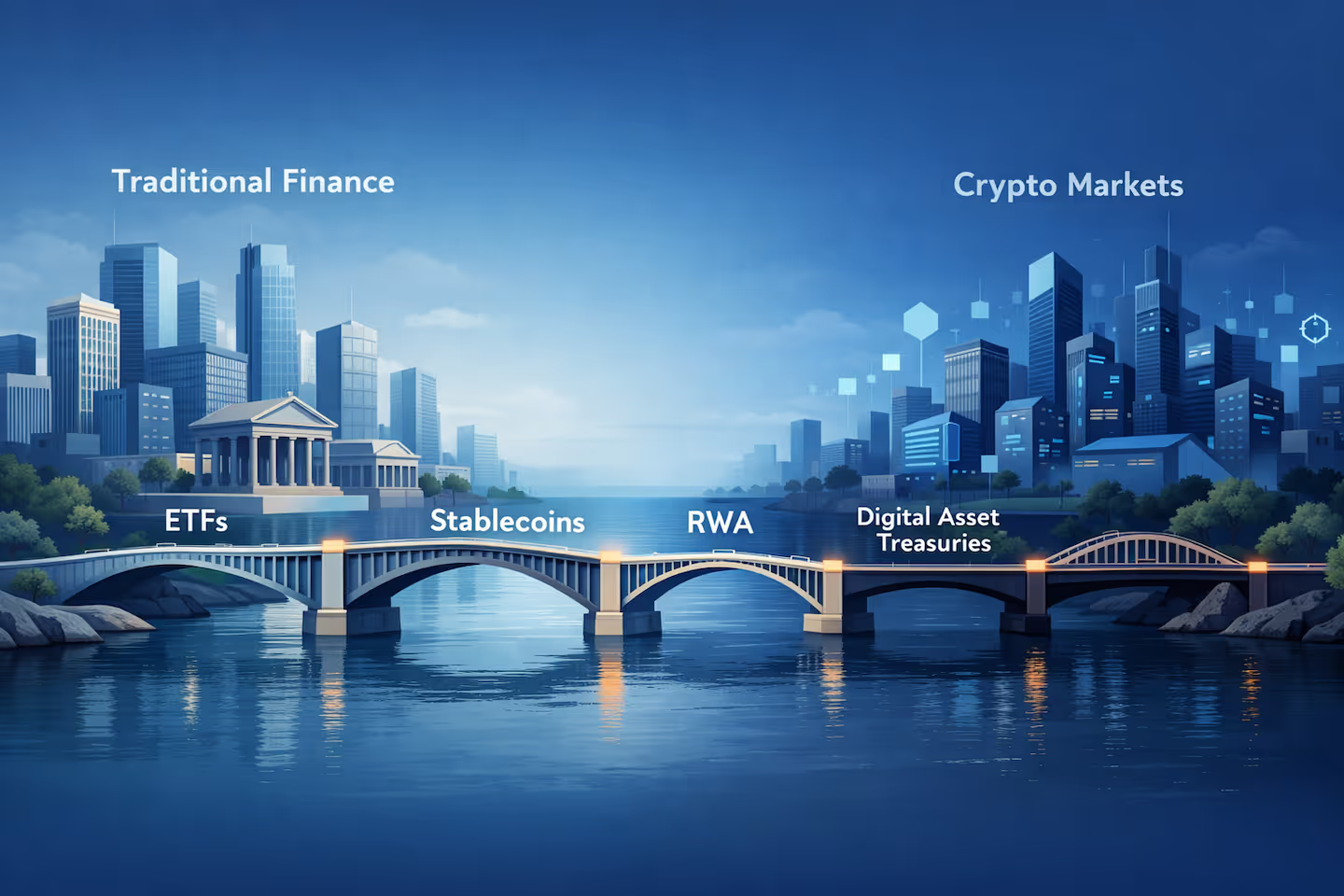
Digital asset markets are being asked to operate under real world financial constraints. ETFs, staking products, real world assets and stablecoins all embed traditional market mechanics into an ecosystem that was not originally designed for them.
Markets are more fragmented than ever. Liquidity is more selective than ever. Precisely for these reasons, market structure has become decisive.
In 2025, capital does not flow to ideas. It flows to markets that can handle it.
The primary winner of this cycle is not a token, a chain or a narrative. It is the infrastructure, liquidity architecture and execution discipline that allow markets to function under stress.
At Portofino, we believe the next phase of digital assets will be defined not by how quickly new products emerge, but by how well markets work when conditions are hardest.
Published on 18.12.2025
Taym Moustapha
Others articles
Thought leadership
How programmable infrastructure reshapes digital asset treasury design and risk.

Thought leadership
A market-maker view on how transparency breaks DeFi execution and why privacy must scale liquidity.