The Return of Financial Privacy
What ZEC's rally reveals about the changing value of financial privacy.
For several years, financial privacy seemed to be moving against the direction of crypto. Privacy coins faced exchange delistings and growing regulatory pressure, while institutional adoption developed around KYC, regulated custody, ETFs and increasingly sophisticated blockchain analytics. At the same time, payments continued to become more digital, leaving increasingly detailed records of financial activity. Zcash, launched in 2016 around the idea that a public blockchain could preserve transactional confidentiality, appeared to belong to an earlier chapter of the industry.
Then ZEC staged one of the most extraordinary rallies in crypto markets. After trading below $250 a year ago and around $500 as late as 19 August, it surged above $800 within days and continued higher through September, briefly approaching $1,700 before retreating towards $1,100 by mid-October. The move coincided with renewed institutional access to ZEC, substantial investment flows and intense derivatives activity. It also spread beyond Zcash. Monero, where privacy is embedded by default rather than offered as an option, has gained more than 70% over the past year. Dash, which is less directly comparable as a privacy asset, also experienced a sharp rally in September before giving much of it back.
It is tempting to read these moves as evidence that financial privacy is returning as an investment theme. Yet price provides only part of the answer. An investor buying exposure to ZEC through an ETF is expressing a view on the future value of the asset without necessarily making a single private transaction. Rising trading volumes tell us that ZEC is changing hands more frequently, rather than why investors are buying it. Even the amount of ZEC held in shielded pools gives an incomplete picture of how frequently those coins are being used for private economic activity.
The distinction matters because the underlying question extends well beyond privacy coins. As cash declines and more payments, deposits and assets migrate towards digital infrastructure, financial activity becomes easier to record, store and analyse. Confidentiality, once partly embedded in the physical nature of money, increasingly becomes something that has to be designed into the infrastructure itself.
Cash kept a payment private because it was a piece of paper. A payment on a digital ledger leaves a record unless someone builds the privacy back in. That is the scarcity the market may be trying to price.
ZEC's extraordinary year gives us an opportunity to test that proposition. The first question is what its rally actually tells us.
What did the ZEC rally actually price?
At first sight, the explanation looks straightforward. Zcash combines two characteristics that became unusually attractive to investors in 2026: a Bitcoin-like maximum supply of 21 million coins and technology specifically designed to enable private transactions. As concerns around financial surveillance returned to the crypto conversation, ZEC offered a relatively concentrated way to express a view that privacy itself might become more valuable.
The arrival of regulated investment access added another source of demand, but also introduced a striking paradox. The investment product built around Zcash does not provide financial privacy. An investor buying ZCSH receives exposure to the price of ZEC through a conventional brokerage account. They cannot make a shielded payment, do not need to interact with the Zcash network and may have no practical interest in using private money.
The product simply makes ZEC easier to own. Investors can gain exposure without opening a crypto exchange account, managing private keys or arranging custody themselves. For institutions, an exchange-listed security can also fit more easily within existing investment frameworks. Yet because the product is backed by ZEC, investment demand can ultimately translate into demand for the underlying token. This created a mechanism through which investors could speculate on the economic value of financial privacy without using privacy themselves.
ETF inflows therefore demonstrated demand for ZEC exposure, rather than demand for private transactions. Privacy may have supplied part of the investment narrative, while the ETF supplied the distribution mechanism. Once ZEC began rising rapidly, it became increasingly difficult to determine how much subsequent demand reflected a view on the future value of privacy and how much simply reflected expectations of further price appreciation.
Market dynamics amplified the move. September's acceleration included significant short liquidations, generating additional buying as bearish leveraged positions were forced to close. Momentum attracted further buyers and ZEC subsequently fell by roughly a third when the rally reversed, while ETF holdings also declined from their highs.
Privacy may therefore have provided the story, while easier investment access, momentum and leverage helped financialise it. The subsequent correction no more establishes that the privacy thesis was wrong than the rally established that it was right.
Liquidity grew with the rally
Portofino's market data also challenge the idea that ZEC simply soared because a small amount of buying hit an illiquid market. Order-book liquidity expanded significantly as the rally developed, with ±2% depth rising from roughly $3 million across the tracked venues during parts of the spring to peaks above $15 million during September and October. Liquidity also became more distributed across exchanges.
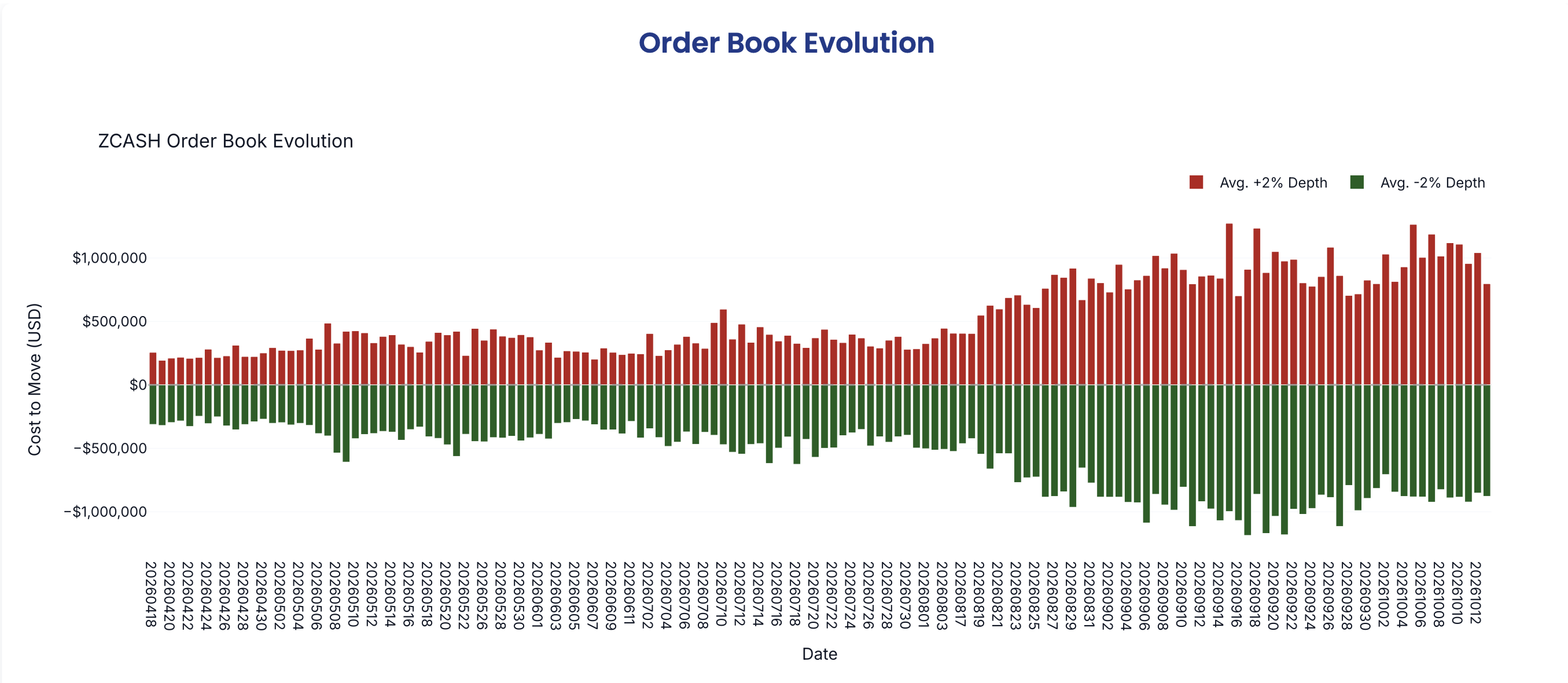
Spreads tightened as participation increased, although the speed of the repricing occasionally pushed prices apart across venues. The picture is consistent with a reflexive process: rising prices attracted activity and liquidity, while deeper markets and tighter spreads made it easier for additional capital to participate.
ZEC was exceptional, but it was not alone
Monero provides the strongest reason to be cautious about explaining the rally entirely through ZEC-specific catalysts. XMR appreciated by more than 70% over the year covered by Portofino's report despite having no equivalent ETF catalyst. Its privacy proposition is in some respects stronger, since transactions are private by default, while access through regulated centralised markets is considerably more constrained.
Monero therefore suggests that something broader than the financialisation of ZEC was taking place. Investors were also repricing an asset whose defining characteristic is privacy, strengthening the argument that privacy formed part of the market narrative. But a rising XMR price, like a rising ZEC price, cannot tell us whether more people were actually using it for financial confidentiality.
Dash adds a useful control. It also experienced a sharp September rally, rising from around $30 to above $70 before retreating, even though privacy is much less central to the asset than it is for Zcash or Monero. Its participation suggests that a broader rotation into older crypto assets was also part of the backdrop.
Taken together, the three markets point to overlapping forces rather than a single “privacy trade”. A broader rotation into legacy crypto assets contributed to the environment. Privacy provided an additional narrative for XMR and particularly ZEC. Zcash then had something neither of the others possessed to the same degree: a rapidly expanding route through which conventional investors could gain exposure to that narrative.

Markets clearly repriced privacy as an investment theme, while ZEC was simultaneously being repriced as an investable asset. But the financial product that helped make ZEC easier to buy did not make Zcash privacy easier to use. Whether the extraordinary increase in investment demand was matched by a comparable increase in the actual use of private money is a different question.
The real privacy question is much bigger than privacy coins
The significance of the privacy debate extends far beyond Zcash, Monero or even crypto. It reflects a more fundamental change in the nature of money itself.
Cash works differently from most forms of digital money. A £20 note passed from one person to another does not create a record of the transaction. Cash therefore provides a degree of privacy almost accidentally, through its physical nature.
Bank money is already less private. Electronic payments create records held by financial institutions, payment processors and sometimes other intermediaries. Those records are not normally public, but they exist and can be analysed or disclosed under certain circumstances. The system offers confidentiality rather than anonymity.
Public blockchains change the model again. Transactions are recorded on a shared ledger that anyone can inspect. Addresses may be pseudonymous, but once an address is linked to a person or organisation, its activity can often be followed over time. That level of transparency may be useful for auditability, but it becomes more problematic as blockchain infrastructure moves closer to ordinary financial activity.
A company may not want competitors to observe its supplier relationships or treasury positions. An investment firm may not want its strategies visible in real time. Individuals may reasonably want their savings, spending and donations to remain private.

The issue becomes more important as stablecoins, tokenised assets and other forms of digital money move financial activity onto programmable infrastructure. If these systems inherit the transparency of public blockchains, financial activity that was previously visible only to trusted intermediaries could become observable much more widely.
This is why the privacy question is larger than whether ZEC or XMR prices rise. It concerns what kind of financial visibility will be built into the next generation of digital money.
In physical money, privacy came partly from the medium itself. In digital money, privacy increasingly has to be engineered back in.
Privacy is not anonymity
The debate around privacy coins is often framed as a choice between transparency and anonymity. In practice, financial privacy has rarely worked in either absolute.
A bank transfer is private from most of the world, but it is not anonymous. The banks know who sent and received it, records are retained and information can be disclosed when legally required. Yet an employer, neighbour or competitor cannot normally inspect the transaction. The financial system already operates through different levels of visibility depending on who is asking.
Blockchains allow those levels of visibility to be designed differently. Zcash is an interesting example because privacy is optional. Users can make transparent transactions, which remain visible on the public blockchain, or “shielded” transactions using its privacy layer. Zero-knowledge proofs allow the network to verify a shielded transaction without publicly revealing key information such as the sender, recipient and amount. Viewing keys can then give an authorised party access to information about shielded activity without giving them control of the funds.
The principle extends beyond Zcash. Zero-knowledge technology can allow someone to prove a fact without revealing all the information behind it. A participant might prove that they have passed an identity check without broadcasting their identity across a network, or an institution that it meets a financial condition without publishing every underlying position.
This becomes increasingly relevant as institutional activity moves onto shared infrastructure. Companies and financial institutions will want confidentiality, while regulators will still require access to information for compliance, sanctions and financial-crime controls. The emerging architecture may therefore combine public information, confidential transactions and mechanisms for selective disclosure.
The important question becomes who can see what, under which circumstances, and with whose permission. ZEC may be the most visible financial expression of the privacy narrative today, but the larger question is whether selective privacy can become a normal property of digital financial infrastructure.
That creates a problem of its own. The transparency of public blockchains is also one of their most powerful security and auditability features. Once information is deliberately concealed, what else do we lose with it?
The uncomfortable side of privacy
Privacy solves one problem by creating another. Public blockchains expose information that users may reasonably want to keep confidential, but that transparency also makes them unusually auditable. Transactions can be traced, balances inspected and, on many networks, the circulating supply independently verified.
Privacy-preserving systems deliberately remove some of that visibility. This protects legitimate users, but can also make illicit flows harder to trace and certain failures harder to detect.
Zcash encountered an unusually clear example in 2026. In May, a critical vulnerability was discovered in Orchard, its principal shielded pool, which could theoretically have allowed counterfeit ZEC to be created inside the pool without leaving a distinguishable on-chain trace. The vulnerability was rapidly fixed and there is no evidence that it was exploited. But Orchard's privacy properties meant there was no way to prove retrospectively from the blockchain that exploitation had never occurred.
Zcash responded in July by activating Ironwood, a new shielded pool built on the corrected circuit. The original Orchard pool was restricted, with funds leaving it required to pass through a “turnstile” designed to prevent more ZEC leaving than had verifiably entered. The objective was to restore independent confidence in the circulating supply while preserving shielded transactions.
The episode captures the trade-off unusually well. Privacy did not cause the vulnerability, but it made one of its consequences harder to observe. The same technology that prevents a competitor from observing a company's treasury activity can also make stolen funds harder to trace.
Privacy therefore changes what security and auditability require. Digital financial infrastructure needs mechanisms that preserve legitimate confidentiality while still allowing participants to verify fundamental properties such as transaction validity and monetary supply. The challenge is to preserve privacy without giving up the verifiability that made blockchain infrastructure valuable in the first place.
The problem with measuring privacy
There is another difficulty with determining whether financial privacy is actually returning: the better privacy works, the harder its adoption becomes to measure.
Transparent blockchains provide an unusually rich set of metrics. Analysts can observe addresses, balances, transaction values and exchange flows. Privacy-preserving systems deliberately remove much of that information. Zcash nevertheless gives us more to work with than some privacy networks because users can choose between transparent and shielded activity.
Around 4.96 million ZEC, or 29% of circulating supply, is currently held in shielded pools. That shows that a substantial amount of ZEC sits within the privacy system, but not how actively it is being used. A rising balance could reflect new users seeking confidentiality, larger amounts being moved into shielded addresses or coins simply remaining there for longer. Recent migration from Orchard to Ironwood makes changes in individual pool balances particularly difficult to interpret.
Transaction activity provides a different test. We analysed daily Zcash network activity from 25 August to 21 October, covering the period in which ZEC rose from around $770 to a peak above $1,650 before retreating. We looked at both fully shielded transactions and the broader share of transactions involving any shielded functionality.
The comparison is revealing. ZEC's extraordinary repricing was not accompanied by an equivalent sustained increase in observable privacy usage. Shielded activity was already substantial and at times represented a large share of network transactions, but remained extremely volatile, with sharp individual spikes rather than a clear upward trend comparable with the rise in ZEC's price.

A fully shielded transaction demonstrates that Zcash's privacy functionality is being used. What it cannot reveal is how many people are behind those transactions or what economic activity they represent. That is precisely the measurement problem: privacy usage can be observed, but much of the behaviour behind it is deliberately concealed. The volatility in shielded activity therefore gives us little basis to conclude that demand for financial privacy was either rising or falling over the period.
Monero makes that problem even more pronounced because privacy is the default rather than an optional feature. Its blockchain can tell us that transactions are taking place, but is deliberately designed to reveal far less about who is transacting, how much value is moving and where it subsequently goes. The absence of those data is partly evidence that the privacy technology is doing what it was designed to do.
What we can say is narrower, but more useful. Zcash's privacy functionality is clearly being used. What the data do not show over this period is privacy usage accelerating at anything like the rate at which the market repriced ZEC.
So is financial privacy actually returning?
The evidence points to three different answers.
In markets, clearly. Privacy returned as a prominent investment narrative in 2026. ZEC's extraordinary repricing, expanding regulated investment access and the simultaneous appreciation of Monero suggest that investors began assigning greater value to assets associated with financial privacy. Zcash was the most dramatic expression of that shift, amplified by easier investment access, momentum and leverage.
In technology, increasingly. As more financial activity moves onto digital infrastructure, confidentiality becomes a more important design question. Zero-knowledge proofs and selective disclosure offer ways to preserve it while still allowing transactions and financial conditions to be verified.
In financial behaviour, the evidence is less conclusive. Zcash's privacy functionality is clearly being used, and shielded transactions at times account for a substantial share of network activity. But our analysis does not show privacy usage accelerating at anything like the rate at which ZEC was repriced.
Markets routinely price expectations before the underlying demand fully materialises. The ZEC rally may therefore have anticipated a world in which financial privacy becomes more valuable as money becomes more digital. Whether that expectation proves prescient will depend on whether demand for privacy eventually follows.
Privacy as a scarce financial property
As money becomes more digital, privacy increasingly has to be deliberately created through technology, institutional rules or both. This may change how financial markets value it.
The more digital money becomes, the more difficult financial privacy may become. And if privacy becomes harder to obtain, markets may increasingly treat it as a scarce financial property.
The ZEC rally may have been an early attempt to price that possibility. Our analysis suggests that the market moved much faster than observable privacy usage during the rally. Whether investors were early or simply caught up in another powerful crypto narrative will depend on what happens next: whether demand for financial privacy begins to follow the expectations markets have already priced in.
Published on 29.10.2026
Taym Moustapha
Others articles

Opinion
Quantum computing will test crypto institutions long before it breaks cryptography.

Opinion
Dilan Bastin on transforming regulatory change into strategic opportunity.